

The short version
Five facts to orient your team
Multiple environmental pressures are converted into a single number of impact points.
Using the display is a choice; once used, official method, declaration and graphic rules apply.
The model normally attaches to a garment reference. A sales unit containing several references is calculated at sales-unit level.
A score must be lodged on the designated portal before it is communicated to consumers.
Third-party publication broadens and other environmental scores trigger a companion display.
Choose your route
Start with the job your team needs to finish
Prepare a style for market
- Confirm SKU and representative product reference.
- Collect composition, mass and production locations.
- Review a method-aligned calculation.
- Approve and export the publication package.
Build a defensible result
- Separate primary, supplier, estimated and default data.
- Resolve required evidence gaps.
- Compare exploratory scenarios.
- Freeze the method version and calculation passport.
Onboard a range or season
- Export from PLM, PIM or ERP.
- Review column mappings and rejected rows.
- Correct the preflight queue.
- Export portfolio status and exceptions.
01 · Overview
More than a carbon label
France's textile coût environnemental is a life-cycle assessment result expressed in impact points. It converts the modeled effects of a garment into a number intended to be understandable at the point of purchase. The score covers climate change alongside water, land, resources, air pollution and ecosystem pressures. Higher totals indicate a larger modeled burden.
The legal basis is the Climate and Resilience Act, followed by Decree no. 2025-957 and the implementing order dated 6 September 2025. The official calculation method entered into force on 1 October 2025. The public calculation service is an open reference implementation, but the regulation is about following the method—not about buying or using one specific software product.
“Voluntary” does not mean informal. A company may decide whether to display the result, yet a communicated result must be calculated, declared and presented under the regulated framework.
02 · Timeline
From enabling law to wider publication
The Climate and Resilience Act provides for environmental labeling and testing across product sectors.
The decree and implementing order appear in the French Official Journal.
The regulated textile method and voluntary display enter into force.
Third parties may calculate and communicate scores without prior brand approval. The companion-display requirement for another textile environmental score also becomes generally applicable.
03 · Scope
Who acts, and which products qualify?
The rules address manufacturers, importers and other parties placing relevant products on the French market. They also govern other people or organizations that calculate or communicate a result. There is no general small-company exemption in the published framework.
Consumer clothing textiles
- Boxers, briefs and underpants
- Socks
- Shirts
- Jeans
- Skirts and dresses
- Swimwear
- Coats and jackets
- Pants and shorts
- Sweaters
- T-shirts and polos
- New and remanufactured products in scope
Products outside the order
- Home textiles and coverings
- Single-use clothing textiles
- Garments containing electronic components
- Products for which more than 20% of mass uses materials absent from the model
- Goods outside the order's clothing-textile scope; verify borderline accessories and footwear against the underlying EU textile regulation
Scope turns on the legal definitions and the current methodological notice. Check unusual composites, protective equipment, sales bundles and emerging product categories against the official texts rather than relying on a marketing category name.
04 · Calculation method
A life-cycle model becomes impact points
The method starts with product-specific facts and life-cycle inventory data. Each environmental result is normalized so unlike units can be compared, then multiplied by its regulatory weighting. The weighted values are combined and supplemented with textile-specific terms. A durability coefficient changes the modeled number of days of use.
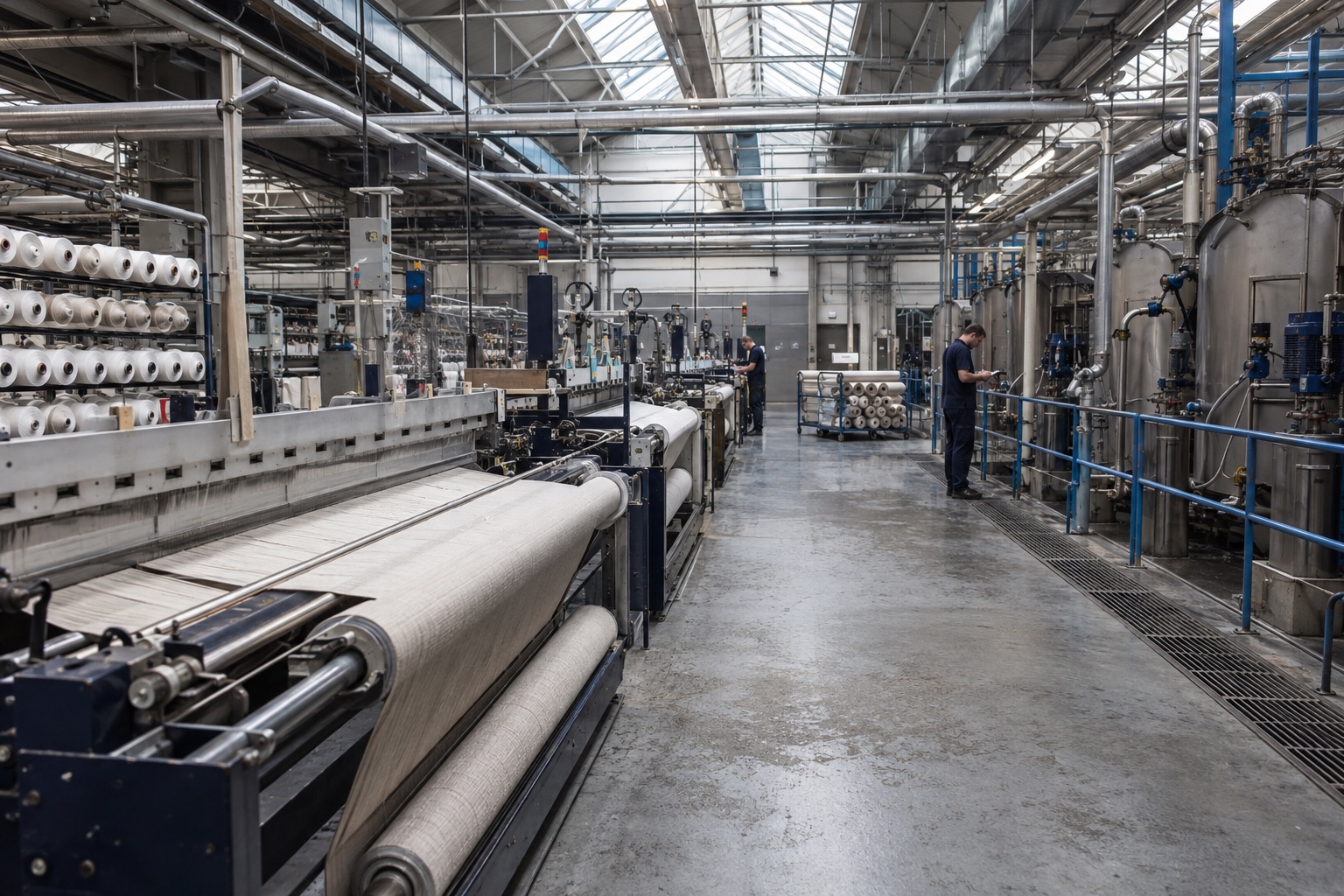
Eight stages are followed
The 16 PEF categories and French weightings
The table below uses the coefficients in Article 5 of the implementing order. The two human-toxicity categories are modeled but currently carry zero weight in the aggregate score. Freshwater ecotoxicity receives 21.06%, and modeled organic molecules in that category are doubled relative to the referenced European recommendation.
| Impact category | Weight |
|---|---|
| Climate change | 21.06% |
| Freshwater ecotoxicity | 21.06% |
| Particulate matter | 7.10% |
| Water-resource use | 6.74% |
| Fossil-resource use | 6.59% |
| Land use | 6.29% |
| Mineral and metal resources | 5.98% |
| Ozone depletion | 5.00% |
| Acidification | 4.91% |
| Ionizing radiation | 3.97% |
| Photochemical ozone formation | 3.79% |
| Terrestrial eutrophication | 2.94% |
| Marine eutrophication | 2.35% |
| Freshwater eutrophication | 2.22% |
| Human toxicity — cancer | 0.00% |
| Human toxicity — non-cancer | 0.00% |
| Total | 100.00% |
Export outside the EU
The method adds an end-of-life term for collected clothing exported outside the European Union and not reused. The order assigns 5,000 impact points per kilogram of clothing in this situation.
Microfiber emissions
A reference value of 1,000 points per kilogram of material is adjusted by fiber-specific release and persistence factors. This brings shedding into the combined result rather than leaving it as a separate note.
Durability coefficient
The coefficient ranges from 0.67 to 1.45 and changes the modeled days of use. Range breadth contributes 50%; repair incentive contributes 50%. The current method addresses non-physical durability, while physical durability remains future work.
05 · Product data
Collect the facts before calculating
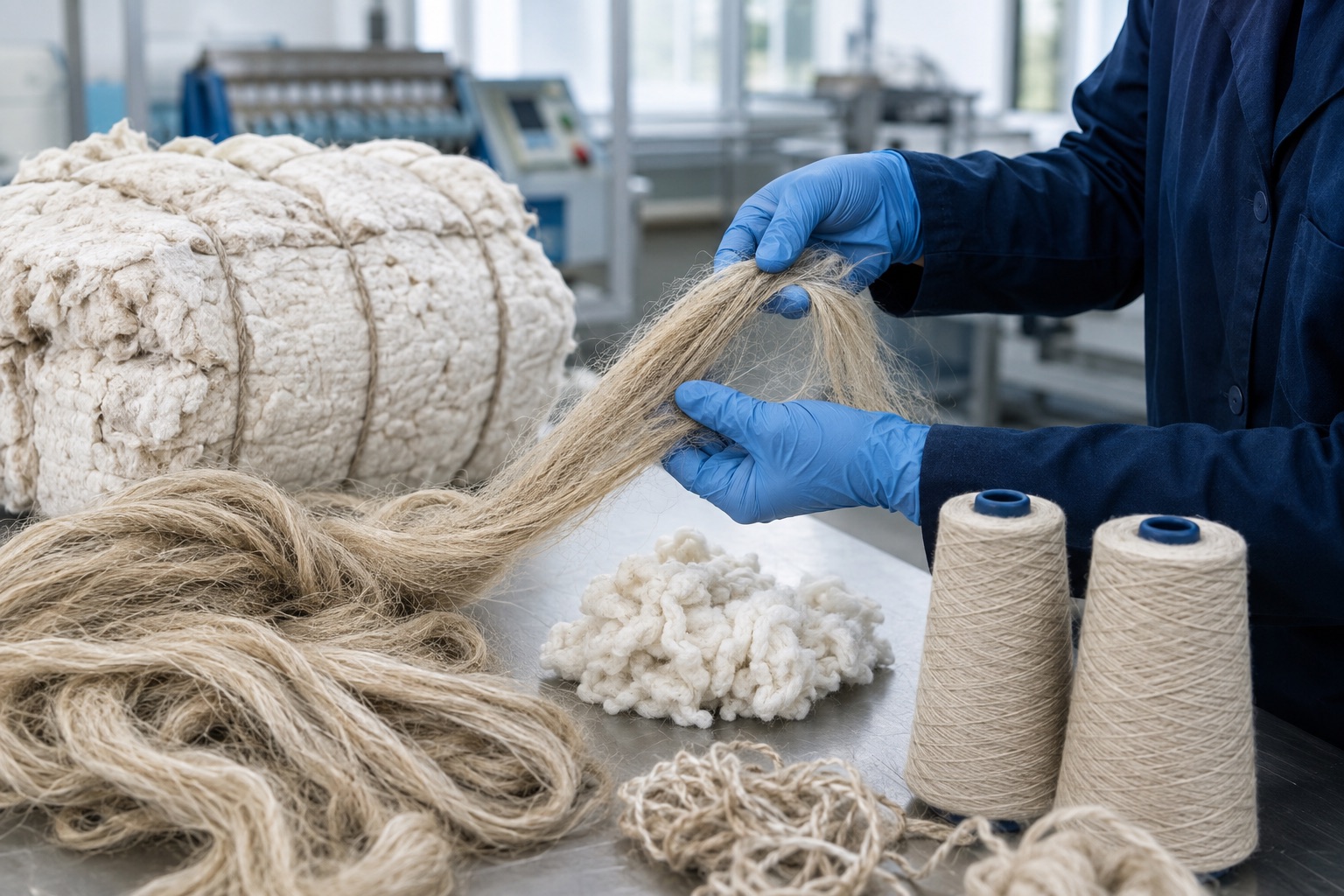
The official method distinguishes inputs that must be specific to the reference from fields that may fall back to prescribed defaults. ADEME groups the minimum product data into four families; the geographic family contains several production-stage locations.
- Product category
- Finished-product mass
- Fiber or material composition and shares
- Key locations: weaving or knitting, finishing or printing, and assembly
These are the foundation of a defensible record. Composition thresholds and representative-size rules come from the methodological notice.
- Remanufactured status
- Number of references in the relevant segment
- Reference selling price
- Company size and repair offer
- Raw-material and spinning origins
- Finishing, printing and washing details
- Air-freight share
- Accessories and trims
Where the method permits a fallback, missing information receives a conservative default. Better primary data can prevent unnecessarily high assumptions.
- Theoretical days of use by product type
- Standard process and loss assumptions
- Inventory datasets and characterization factors
- Normalization and weighting coefficients
- Material-specific microfiber factors
- Default values defined by the official notice
Do not overwrite fixed method values merely because internal systems use a different convention.
Record whether every field comes from primary data, documented supplier evidence, an estimate or an official default. This provenance is essential for review and future recalculation.
06 · Why calculate and how to publish
Owning the record reduces uncertainty
From 1 October 2026, a retailer, comparison service, NGO or other third party may calculate and communicate the Environmental Cost from available or estimated data without obtaining prior approval. Before that date, the manufacturer or market placer must have agreed or already published the result on the official portal.
A third party normally has less supply-chain detail and may need conservative defaults. A calculation published by the manufacturer, importer or market placer becomes the result others must use; existing third-party communication must be updated within one month. Preparing the record yourself therefore improves data control even though the display remains voluntary.
Calculate
Use the official method through the public calculator, its API or another conforming implementation.
Quality-check
Confirm the reference, representative size, material shares, locations, defaults and methodology version.
Declare first
Submit the result and required record to the government portal before consumer communication.
Display
Use the official unaltered graphic and link a digital display to the public product record.
What the portal record contains
- The total Environmental Cost in impact points
- The breakdown by required impact categories and the durability coefficient
- Information identifying the product reference
- The calculation date, the legal nature of the person or entity that performed it, and the method version
- The parameter data needed by authorized control and policy teams
07 · Display and maintenance
The number and its presentation travel together
If communicated, the Environmental Cost must be accessible when the product is bought.
The graphic contains total impact points and the result recalculated per 100 g.
The prescribed graphic cannot be altered. It may only be scaled proportionally.
Online or app displays must link to the information made available through the declaration record.
On shelf or online, the graphic must be at least as large as the price figures; on product or packaging it must remain legible.
It must be at least as prominent as any other environmental score shown for the same reference.
08 · French method and PEFCR
Related foundations, different policy jobs
Both approaches use life-cycle assessment and the European Environmental Footprint family of indicators. The French system adapts that foundation for a national, consumer-facing policy instrument; the apparel and footwear PEFCR is a sector rulebook for producing comparable European Product Environmental Footprint studies.
| Question | French Environmental Cost | Apparel & footwear PEFCR |
|---|---|---|
| Primary role | Regulated French consumer display | European sector rules for PEF studies |
| Product scope | Specified clothing textiles | Apparel and footwear categories |
| Aggregate output | Impact points under French coefficients | Results under the applicable PEF method and category rules |
| Textile additions | Microfiber and extra-EU export terms enter the score | The current PEFCR does not yet incorporate microplastic shedding; the Commission identifies it as an area for future refinement |
| Durability | Current coefficient focuses on range breadth and repair incentive | Product-lifetime modeling follows the sector rules rather than the French non-physical durability coefficient |
| Publication | Government portal and official display graphic | No equivalent French declaration workflow |
09 · Readiness checklist
A practical route from catalog to declaration
10 · Frequently asked questions
Common implementation questions
Is the display compulsory for every garment today?
No. The textile framework is voluntary but regulated: choosing to communicate the score triggers rules on calculation, declaration and presentation. Until 1 October 2026, the companion-display rule for another environmental score applies only where the manufacturer, importer or market placer has already calculated and communicated Environmental Cost. From that date, the requirement becomes general.
Does a lower number mean a better result?
Yes. Impact points represent modeled environmental burden, so a lower Environmental Cost indicates a lower modeled impact. Compare like-for-like product categories and review the underlying data before drawing conclusions.
Can one score cover every color and size?
A reference shares technical characteristics such as color, composition, shape and texture; size variations are excluded from that definition. The implementing order uses one representative size for a market segment, and the result applies to the other sizes in that segment. If several references are bundled in one sales unit, the calculation is made for that sales unit instead.
Must companies use the public calculator?
No. Operators may use another calculation system, but the output must follow the official method. The public service is useful as a transparent reference implementation and provides an API.
What happens when data is missing?
Only the parameters identified as eligible for defaults may use them. The official method applies conservative, impact-increasing assumptions where optional information is absent. Required product-specific fields cannot simply be replaced by convenient estimates.
Is this the same as a carbon footprint?
No. Climate change is one weighted category. Environmental Cost also accounts for water, land, resource use, pollution and ecosystem pressures, then adds textile-specific adjustments.
11 · Primary references
Check the source, not just the summary
This guide is educational and not legal advice. The links below are the primary materials used to cross-check it as of September 5, 2026.
- Decree no. 2025-957 of 6 September 2025
Core rules for calculating and communicating textile Environmental Cost.
- Implementing order of 6 September 2025
Scope, methodology, parameters, weighting and display requirements.
- French Environmental Code, textile subsection
Consolidated Articles D.541-240 to R.541-246.
- ADEME — Method and data
Official overview of life-cycle stages, textile additions and required data.
- ADEME — Current rollout
Deployment status and links to calculation and declaration services.
- Official calculation service
Public calculator, methodology and data explorer.
- Official declaration portal
Portal named by Article 9 of the implementing order.
- European Commission Recommendation 2021/2279
The Environmental Footprint method behind the 16 impact categories.
- EU apparel and footwear PEFCR update
European Commission overview of the sector-specific product rules.